
In this article
- 1. Collecting and checking documents
- 2. Bookkeeping
- 3. Tax returns
- 4. Payroll and social security
- 5. Assessment and payment notice
- 6. Periodic and annual work
- Standard scope and extras
- 7. Reporting and advisory
- Sole proprietorship versus company
- What affects the monthly fee?
- What is needed on your side?
- Frequently Asked Questions
- In Short
Short answer: A monthly accounting service covers booking purchase and sales documents and bank transactions, the VAT return, the withholding and social security return, payroll and social security filings for any employees, notifying you of amounts due, and periodic provisional tax and annual returns. Company formation, corporate changes, VAT refunds and special reports are usually planned separately.
"What exactly does my accountant do?" is one of the questions business owners ask most. Knowing the scope helps you set expectations and compare quotes properly. This article walks through the tasks repeated every month in Ankara accounting services.
1. Collecting and checking documents
Each month starts by collecting the previous month's documents: purchase and sales invoices, e-archive and e-invoice records, expense receipts, bank and credit card statements, rent and subscription documents. If you use e-invoicing, most documents arrive in the system automatically; paper documents can be sent as photos or scans.
At this stage the financial advisor does not just receive documents but checks them. If an invoice is not issued in your name, a receipt has the wrong VAT rate or a bank transaction is missing, they let you know. This check prevents gaps at month end. To learn which costs are deductible, see our guide to deductible business expenses.
2. Bookkeeping
Documents are recorded according to the type of books your business keeps. Sole proprietorships usually keep a business ledger, while companies keep a journal and general ledger on a balance-sheet basis. If you are within the e-ledger scope, records are created electronically and berat files are uploaded at set intervals. Bank reconciliation, account tracking and stock movements are also processed here.

3. Tax returns
Returns are the most visible part of monthly accounting. As a general rule, these are filed every month:
- Withholding and social security return (muhtasar): Withholding on wages, rent and freelance payments plus social security notifications; by the 26th.
- VAT return: The difference between VAT on your sales and deductible VAT on purchases; by the 28th.
- Stamp tax: Usually reported together with the withholding return.
In addition, sole proprietors pay the Bağ-Kur premium by the end of each month. The calendar below shows the key dates of a month.
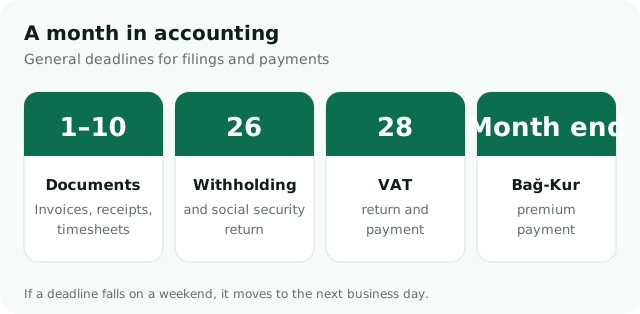
For dates that change through the year and periodic filings, see our 2026 tax calendar.
4. Payroll and social security
If you have employees, payroll is prepared every month; social security, unemployment insurance, income tax and stamp tax are deducted from gross pay. Hiring and termination notices, missing-day reports and incentive applications are also included. To see gross-to-net pay, use our salary calculator. If you are hiring for the first time, our first employee payroll checklist helps.
Many offices price payroll separately by number of employees. See our payroll and social security page for details.
5. Assessment and payment notice
After returns are filed, tax and premium assessments are created. A good service sends you these amounts in writing with the payment deadline so you can plan ahead. Late payments incur late interest; see the potential cost with our late payment interest calculator.
6. Periodic and annual work
- Provisional tax return each quarter (in May, August and November).
- Annual income tax in March and corporate tax in April.
- Year-end inventory, depreciation and closing entries; balance sheet and income statement.
- e-Ledger berat uploads and ledger closing.
Standard scope and extras
The table shows what is usually standard and what is planned separately. Since offices differ, it is important to see each item in the contract.
| Task | Frequency | Usually |
|---|---|---|
| Booking documents and bank reconciliation | Monthly | Standard |
| VAT return | Monthly | Standard |
| Withholding and social security return | Monthly | Standard |
| Assessment and payment notice | Monthly | Standard |
| Provisional tax return | Quarterly | Standard |
| Annual income or corporate tax | Yearly | Standard |
| Payroll and social security filings | Monthly | By number of employees |
| e-Invoice and e-ledger setup | Once | Extra |
| VAT refund file | As needed | Extra |
| Corporate changes and liquidation | As needed | Extra |
| Management report and budget | Monthly or periodic | Depends on package |
7. Reporting and advisory
Accounting records are not kept only for tax; they are the most reliable view of your business. Periodic profit-and-loss summaries, estimated tax, receivables and payables make decisions easier. For regular reports, see our financial reporting and advisory service. Before decisions such as a new investment, a vehicle purchase or more staff, the tax impact should be calculated. Tracking regulatory changes and explaining how they affect your business is also part of a good monthly service.
Sole proprietorship versus company
The monthly list looks similar for both, but the depth differs. Sole proprietorships usually keep a business ledger, track Bağ-Kur and file an annual income tax return. Limited and joint-stock companies keep balance-sheet books and have additional duties such as corporate tax, partner accounts, general assembly and ledger certification. Partners' Bağ-Kur status is tracked separately. If you have not decided, read sole trader or limited company.
What affects the monthly fee?
- Company type and type of books.
- Monthly number of purchase and sales documents.
- Number of employees and payroll volume.
- Activities requiring special records, such as e-commerce, export or construction.
- Expectations for reporting and advisory.
When comparing quotes, look not just at the figure but at what it covers. Two similar-looking quotes can differ greatly in scope.
What is needed on your side?
Three things are enough: send documents in the first days of the month, grant read access to bank accounts, and notify major transactions (vehicle purchase, new lease, new hire) in advance. Once this routine is set, month-end stress largely disappears.
Frequently Asked Questions
Is payroll included in monthly accounting?
It depends on the office. Many price payroll separately by number of employees. State your headcount when asking for a quote and confirm in writing whether payroll is included.
When should I hand documents to my accountant?
Ideally within the first ten days of the following month, so returns are prepared before the deadline and amounts reach you in time.
Is the annual return charged separately?
In most monthly contracts the annual income or corporate tax return is included, but some offices charge for year-end work. The contract should state this clearly.
Does e-invoicing reduce the accounting work?
Collecting documents gets easier, but checking, booking and filing continue. See our e-invoicing page for details.
Can I receive monthly accounting without visiting an office?
Yes. Documents are sent by e-mail, message or online folder, and returns and amounts are shared digitally. We describe this in online accounting.
How do I compare scope when choosing an accountant?
Fill in the table above for each quote. For other criteria, see how to choose an accountant in Ankara.
Is a return filed for a month with no transactions?
Yes. As long as your business is active, some returns such as VAT must be filed even with no transactions; these are called "nil returns".
In Short
A monthly accounting service is a recurring cycle from booking documents to filing taxes and premiums on time. Clarifying the scope up front helps you manage both cost and expectations.
If you are looking for accounting services in Ankara, review our scope on the bookkeeping and accounting page or contact us for a tailored quote. We can meet at our Kızılay office or online.