
In this article
Short answer: In 2026 most businesses file and pay VAT by the 28th and the withholding and social security return by the 26th of the following month. Provisional tax is due by 17 May, 17 August and 17 November. Annual income tax is filed in March and corporate tax in April. If the last day is a weekend or a public holiday, the deadline moves to the next business day.
Most penalties come from a missed date, not a wrong formula. This page collects the 2026 calendar for sole traders and companies in Ankara. The dates are the general rule; a sector-specific period or an official extension overrides them.
Which return falls when?
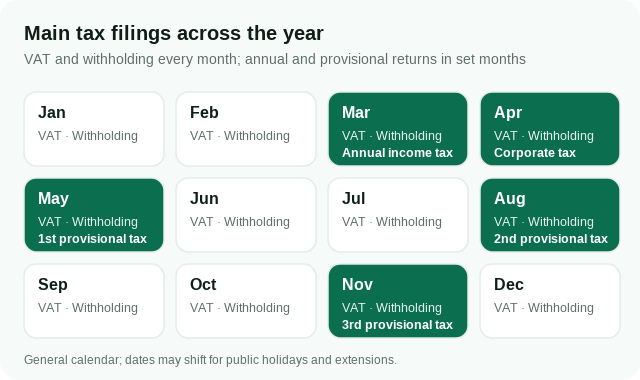
The chart shows a typical year for a business that keeps double-entry books and has employees. A sole trader on the operating-account method with no staff may not file withholding or provisional tax every month. If you are unsure which books you keep, see what monthly accounting includes.
Returns that repeat every month
| Return or payment | Period | Deadline |
|---|---|---|
| Withholding and social security | Previous month’s payroll, withholding and social security | 26th of the following month |
| VAT | Previous month’s output and input VAT | 28th of the following month |
| Stamp duty | Documents subject to declaration | With the withholding return |
| Bağ-Kur premium | The current month | Last day of the month |
| Ba-Bs forms | Purchases and sales above the threshold | Last day of the following month |
The withholding and social security return combines payroll withholding, rent and freelance withholding, and social security notifications. A business with no staff and no withholding may not file it every month. The VAT return is monthly for almost every VAT taxpayer. You can test an amount with the VAT calculator.
Ba-Bs forms match purchases and sales above a threshold with the other party. The threshold is updated each year. A form that does not match the counterparty’s return is a common reason for a tax office question, so the form is part of the monthly reconciliation, not a side task.
Provisional tax
Companies and sole traders on double-entry books file provisional tax three times a year. Filing and payment are due by the 17th of the second month after the quarter: 17 May, 17 August and 17 November. There is no provisional return for the fourth quarter; that profit is taxed on the annual return.
Provisional tax is an advance on the year-end tax and is credited on the annual return. You do not have to pay a high amount every quarter just because sales look strong; documented expenses and stock reduce the quarterly profit. When an expense can be booked is covered in deductible business expenses.
Annual returns
The annual income tax return for 2025 is filed between 1 and 31 March 2026 and paid in two equal instalments, by the end of March and the end of July. Corporate tax for the 2025 fiscal year is filed between 1 and 30 April 2026 and paid by the end of that month. Limited and joint-stock companies pay corporate tax. Sole traders pay income tax.
The annual return is not a summary of the VAT returns you already filed. Income and corporate tax are charged on profit. VAT can arise even in a loss-making month because it follows sales. Mixing the two is the usual reason for a surprise in March or April. You can see the income tax brackets on your own profit with the income tax calculator.
Bağ-Kur and social security payments
Sole traders and limited company partners pay a Bağ-Kur premium every month, separate from the tax returns. The deadline is the last day of the month the premium belongs to. Paying on time, with no premium debt, is what keeps the 5-point discount. The 2026 amounts are in Bağ-Kur premium 2026.
For employers, the social security premium is declared on the withholding and social security return and paid by the 26th. The hiring notice is a different deadline: it is due before work starts. The order for a first employee is in the payroll and social security checklist.

e-Ledger and e-Notification
Businesses on e-Ledger upload journal and general-ledger certificates within the legal period after the month they belong to. A late certificate can be a separate irregularity even if the tax return was filed. Monthly booking therefore has to finish before the filing day. e-Invoice scope is a different topic, covered in e-Invoice and e-Archive.
e-Notification delivers tax office letters to an electronic address rather than a letterbox. A notice counts as served after the legal period even if you do not open it. Checking once a month is the practical way to keep objection and payment windows open.
What happens if you miss a date?
A late return can bring an irregularity penalty. A late payment brings late-payment interest, which accrues monthly on the debt. A small VAT amount left for a few months can cost more than the tax itself. See the cost with the late payment interest calculator.
A missed return should not sit until someone notices. Filing voluntarily, before the tax office contacts you, can mean a lower penalty. If that is your situation, clarify it under tax advisory first, then file.
Three habits that keep the calendar
- Send documents in the first week of the month. Invoices that arrive on the 20th leave no room to correct the 26th and 28th filings.
- Learn the amount a few days before the deadline and keep it in the account. An assessment slip is not the same thing as the payment day.
- Check e-Notification and the e-Government debt screen once a month. An invoice someone else issued in your name can create VAT you have not seen.
These three habits are also the core of bookkeeping and accounting. The office sends the amounts due, with a short explanation, before each filing period. You pay through online banking or the tax authority screens.
How the year actually feels
January and February are only the monthly returns: the previous month’s withholding and VAT. In March, annual income tax is added. For a sole trader, March is the tightest cash month, because February’s VAT and the first income tax instalment can fall in the same weeks. In April, limited and joint-stock companies pay corporate tax. Provisional tax falls in May, August and November, and the second income tax instalment falls in July.
If you set aside “the same amount every month” without seeing these clusters, March and May strain the account. A practical method is a separate balance for monthly VAT and Bağ-Kur, plus an extra amount once quarterly profit is roughly known. Our Ankara office sends those figures in writing before the filing. A surprise usually comes from a document that arrived late.
A newly formed business can look quiet at first. With no sales there is no output VAT, but input VAT on purchase invoices carries forward. That balance is an asset, not income. When the first sale starts, output VAT is reduced by the carried amount and only the remainder is paid.
Frequently Asked Questions
What if the 26th or the 28th is a weekend?
The deadline moves to the end of the next business day. Public holidays work the same way. If you track the calendar yourself, check that month’s weekdays once.
Do I file withholding if I have no employees?
If you make no payment subject to withholding, you may not file every month. Workplace rent, a freelance payment or wages create a return for that month. If you are unsure, ask before you skip the month.
If I overpaid provisional tax, does it correct itself?
An overpayment is credited on the annual return, or it may be refunded. An underpayment is completed with late interest. Waiting until year end makes the shortfall more expensive.
Does a sole trader file corporate tax?
No. A sole trader’s profit is declared on the income tax return in March. Corporate tax belongs to limited and joint-stock companies and is filed in April.
In short
In 2026 the regular dates are three: withholding on the 26th, VAT on the 28th, Bağ-Kur at month end. Add provisional tax in May, August and November, income tax in March and corporate tax in April. A weekend deadline moves to the next business day.
For the filing calendar and a payment plan, see tax advisory, or contact us to talk through your own period.