In this article
- Three basic conditions for a deduction
- Expenses couriers can deduct
- Fuel: the largest expense
- Maintenance, parts and insurance
- Motorcycle and depreciation
- Phone, line and equipment
- Rent and bills if your home is the business address
- A deduction saves in two ways
- Non-deductible items
- Practical document tips
- Frequently Asked Questions
- In Short
Short answer: Couriers can deduct spending that is directly business-related and documented in their name: fuel, maintenance and repairs, tyres and spare parts, compulsory traffic insurance and comprehensive cover, motor vehicle tax, a work phone and line, work equipment such as helmets and jackets, Bağ-Kur premiums and accounting fees. If the motorcycle is registered in the business, its cost is deducted over the years through depreciation. Traffic fines and personal spending cannot be deducted.
Recording expenses is the most effective legal way to reduce tax. Every documented expense both lowers your taxable profit and lets you deduct the VAT on the invoice. This guide covers what couriers can deduct, the document rules and common mistakes.
Three basic conditions for a deduction
For spending to be accepted as an expense, three conditions apply together:
- Business-related: It must be made for your courier activity.
- Documented: There must be an invoice or receipt in your name and tax number.
- Recorded in its period: It must be booked in the period it belongs to.
The test is whether the spending was made to earn and maintain income. In field work like courier delivery, this link is clear for most items; still, you should be able to explain why each expense was made if asked.
If one condition is missing, spending may not be accepted even if it really happened. For general rules, see deductible business expenses.
Expenses couriers can deduct
| Expense | Deductible? | Document and note |
|---|---|---|
| Fuel | Yes | Invoice or till receipt with tax number |
| Maintenance, repairs, oil change | Yes | Service or mechanic invoice |
| Tyres and spare parts | Yes | Invoice; large amounts may be fixed assets |
| Traffic insurance and comprehensive cover | Yes | Policy and receipt |
| Motor vehicle tax | Yes | If the motorcycle is in the business |
| Phone and mobile line | Yes | Invoice; mind the personal-use share |
| Helmet, jacket, gloves, bag | Yes | Invoice; must be work-specific |
| Motorcycle cost | Via depreciation | Invoice and registration; spread over years |
| Bağ-Kur premiums | Yes | Payment receipt |
| Accounting fee | Yes | Freelance receipt or invoice |
| Traffic fines | No | Not deductible by law |
| Personal meals and clothing | No | Not directly business-related |
Fuel: the largest expense
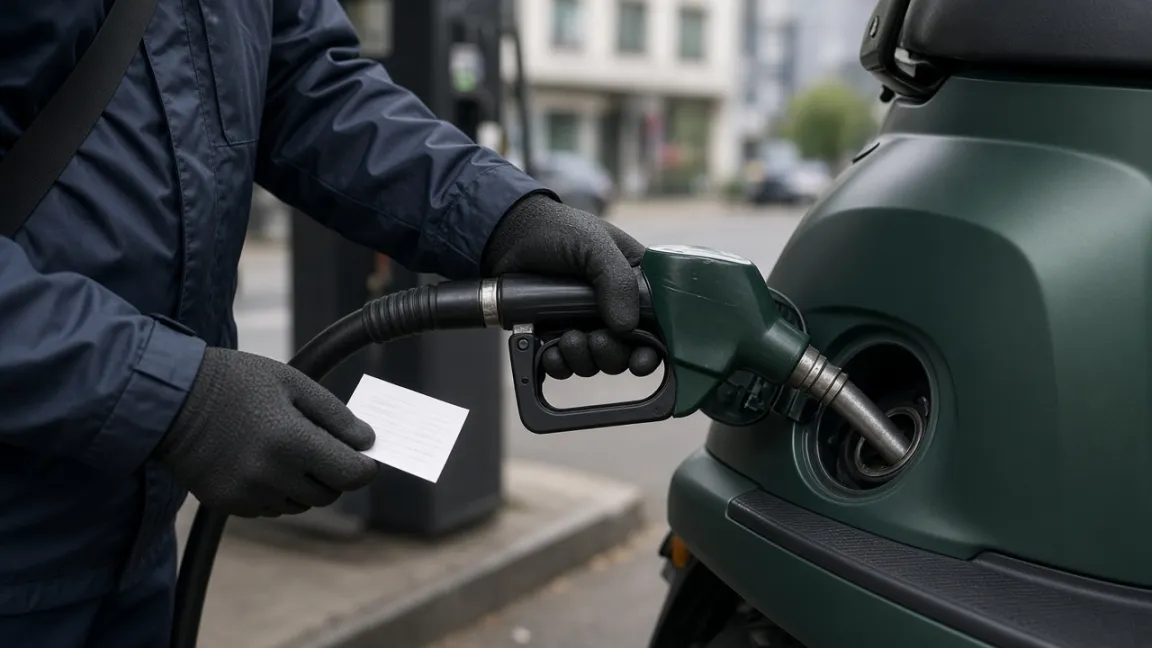
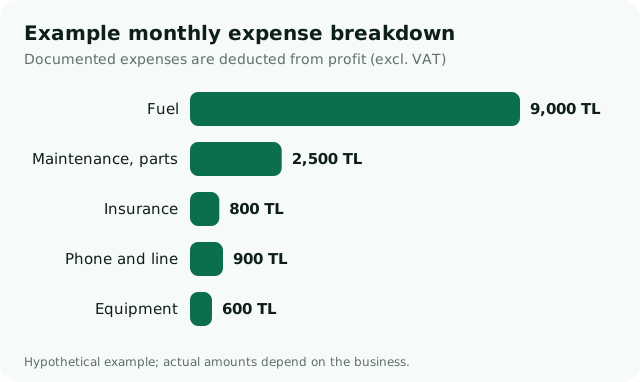
Fuel is the largest share of a courier's monthly costs. Tell the cashier your tax number; your name and tax number must appear on the receipt or invoice. Receipts without a number may be rejected. Some stations can issue a consolidated e-invoice to your tax number, which prevents lost documents and simplifies tracking.
If you have several vehicles or family members use the same station, buy only the fuel for your work motorcycle in the business's name. Showing fuel for a private car as a business expense can lead to rejection and penalties in an audit.
Fuel use should also be proportionate to your activity. Fuel costs out of line with distance and deliveries can raise questions in an audit.
Maintenance, parts and insurance
Periodic maintenance, oil changes, brake pads, chains and tyres are deducted directly. Large one-off repairs or upgrades that increase the motorcycle's value may be depreciated depending on the case. Traffic insurance is compulsory and deductible; comprehensive cover is also accepted for a motorcycle registered in the business. Insurance policies carry no VAT, so they create no input VAT.
Motorcycle and depreciation
A motorcycle is used for more than a year, so it is not expensed in one go in the year of purchase. Its cost is spread over the years according to the useful life in the depreciation list. For example, with a five-year useful life, one fifth of the cost becomes an expense each year under the normal method. Try your numbers with our depreciation calculator.
To take depreciation, the motorcycle must be registered in your name and recorded in your business. If bought on credit, loan interest may also count as an expense or cost element depending on conditions. Buying after opening your business is cleanest for records; we cover this in how a courier opens a sole proprietorship.

Phone, line and equipment
Courier work is impossible without a smartphone and mobile data, so phone and line bills are deductible. If you also use the line personally, setting a reasonable business share is more defensible. The phone itself is expensed directly or recorded as a fixed asset depending on its amount.
Work-specific equipment such as helmets, protective jackets, gloves, rain gear and delivery bags is also deductible. Assets below a threshold updated each year can be expensed directly; those above it are depreciated. Always ask for an invoice for equipment the platform sells you.
Rent and bills if your home is the business address
If your home is your registered business address, part of rent, electricity and internet may be deductible. This can create extra obligations such as rent withholding, and the share must be reasonable. See rent withholding with our rent withholding calculator. We recommend reviewing this with your financial advisor first.
A deduction saves in two ways
A documented expense reduces your tax in two ways. First, the amount excluding VAT is deducted from profit, lowering year-end income tax. Second, the VAT on the invoice is recorded as input VAT, lowering that month's VAT payable. For example, on a TL 1,200 fuel invoice including VAT, TL 200 VAT is deducted from that month's VAT payable and TL 1,000 from annual profit.
So skipping a receipt is not just losing a small amount. Undocumented spending accumulated over a year makes a significant difference on both VAT and income tax.
Non-deductible items
- Traffic fines: Not deductible by law.
- Personal spending: Groceries, personal clothing and family costs.
- Undocumented spending: No receipt or invoice, or documents in someone else's name.
- Your own meals: The owner's own meals are generally not accepted.
Practical document tips
In courier work, receipts are easily lost, fade in heat or get wet. These methods help:
- Photograph each receipt when you get it and send them together at month end.
- Get a consolidated e-invoice for fuel where possible.
- Use a separate bank card for business spending.
- Send documents to your advisor weekly rather than waiting for month end.
This routine ensures expenses are fully recorded. Even a few lost receipts a year can noticeably raise your tax. We explain the full calculation in our motorcycle courier tax guide.
Frequently Asked Questions
Can a courier deduct fuel receipts?
Yes, as long as your name and tax number appear on the receipt or invoice, fuel is deductible and its VAT is deducted. Receipts without a number may be rejected.
Can I deduct the whole motorcycle in the year I buy it?
No. Because it is used for more than a year, its cost is deducted through depreciation over its useful life.
Are traffic fines deductible?
No. Monetary penalties such as tax and traffic fines cannot be deducted from profit by law, even when paid.
Are Bağ-Kur premiums deductible?
Yes. Bağ-Kur premiums you pay are taken into account in business profit and reduce taxable profit. For 2026 amounts, see Bağ-Kur premium 2026.
I use my phone for work and personal life; can I deduct it?
Yes, but setting a reasonable business share is better. If the line and device are mainly for courier work, the full bill can be deducted; with mixed use, the business share.
Are platform deductions expenses?
If the platform invoices you for equipment or service charges, those amounts are deductible and their VAT can be deducted. For deductions without invoices, request documents from the platform.
What if I lose a receipt?
Spending without a document cannot be deducted. You can request a copy from the issuer; if it was an e-invoice or e-archive invoice, an electronic copy is always available.
In Short
For couriers, the biggest factor in tax burden is how completely expenses are documented. Getting a document in your name for every business expense directly reduces year-end tax.
If you are looking for a team that collects your documents and knows how each expense is recorded, see our motorcycle courier accounting service. We work with couriers in Ankara from our Kızılay office and online; contact us with questions.