
In this article
Short answer: E-commerce accounting is revenue for the sale price, an expense for the platform’s cut, a correction for returns, and a separate track for stock. The net amount in the bank is not turnover. VAT is the tax on the sale price and is filed by the 28th of the following month. e-Invoice or e-Archive arrives, for many online sellers, together with the registration. The books stay orderly when every channel’s report flows into the same chart of accounts.
In Ankara, e-commerce can run from a shelf at home or a warehouse in Etimesgut. The customer may be in another city; the tax registration still sits with the tax office of the workplace. This guide explains how to keep a marketplace and your own site in one set of books. The version that focuses only on the marketplace statement is the marketplace tax guide.
What sits inside one sale
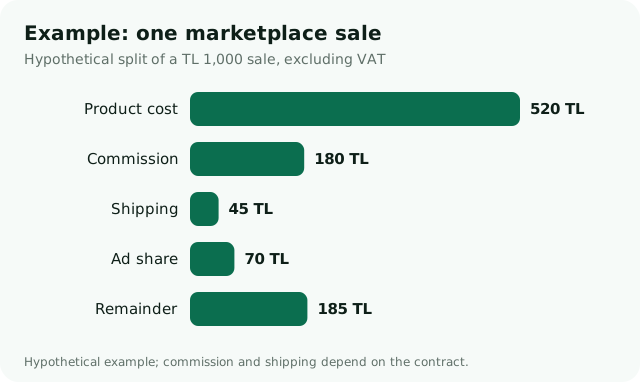
After product cost, commission, shipping and ads, the remainder of a TL 1,000 sale is not profit by itself. Packaging, software, the warehouse and your own time still sit inside it. The chart shows where the complaint “turnover is high, there is no profit” usually comes from. Each item is an expense only with its own document. Commission is documented by the platform’s invoice; shipping by the carrier’s invoice. Making them one line on the statement weakens both the VAT deduction and the expense.
On your own site there may be no commission, and instead a card-processor fee and shipping. The processor fee is also an expense with an invoice. If the carrier collects cash on delivery, the collection and the deduction are still separate lines. What the customer paid is revenue; the deduction is an expense.
One set of books, channel by channel
| Channel | Revenue document | Typical deduction |
|---|---|---|
| Marketplace | e-Archive / e-Invoice and the sales report | Commission, shipping, ads, penalty fees |
| Own website | e-Archive / e-Invoice | Card fee, shipping |
| Social selling | The same electronic documents | Ads and shipping |
| Wholesale / B2B | e-Invoice, to a registered buyer | Usually no commission; there is a payment term |
All four channels are written to one tax registration. Opening a company per channel does not simplify the accounts; it multiplies Bağ-Kur, returns and bank accounts. What you want to track separately is the sales report, not a new company. Each channel’s monthly report stays in its own folder, and the journal goes to the same accounts.
On a B2B sale the buyer may be an e-Invoice user. The document is then an e-Invoice, not e-Archive. The difference is in e-Invoice and e-Archive. The wrong type can go as far as the document being treated as never issued.
Stock, returns and loss
In e-commerce, stock is the invisible side of profit. When you buy a product it is stock, not an expense. When you sell it, the cost meets the sale. When it is returned it comes back to stock and revenue falls. Writing all three movements to one “everything is an expense” account inflates or erases profit during the month.
Waste, a lost parcel and a defective return need their own record. A shortage without a record is like an undocumented expense. The count is your job even if the warehouse is outside Ankara. Do it at the latest before the annual return, and preferably each quarter. Provisional tax can come out high because of wrong stock. The general split between expense and stock is in deductible business expenses.

VAT and the other filings
Output VAT is the tax on the sale price. Input VAT is the tax on purchase, commission and shipping invoices. The amount payable is the difference. If input VAT is larger, it carries forward. A carried balance is not income. Build your own example with the VAT calculator.
A sole trader files income tax in March; a limited company files corporate tax in April. On double-entry books, provisional tax falls in May, August and November. The full set of dates is in the 2026 tax calendar. If you have not chosen a structure, see sole trader or limited company. Most sellers who start alone open a sole proprietorship; a limited company is discussed when a partner, stock risk or a corporate buyer appears.
Bağ-Kur is monthly for a registered sole trader and for limited company partners. Calling the work “side income” does not remove the premium. The 2026 amounts are in Bağ-Kur premium 2026.
A routine for closing the month
- Download each channel’s sales and returns report in the first week.
- Match platform, carrier, card and advertising invoices to the report lines. Do not expense a commission that does not match.
- Check stock issues against units sold, and stock receipts against units returned.
- Look at the VAT draft a few days before the 28th. Keep the payable amount in the bank.
- Keep personal spending off the business account. A mixed account becomes an argument about expenses at month end.
This routine runs without a monthly visit to the office. Documents arrive by photo, e-mail or a shared folder, and the return is filed electronically. The security of that process is in how online accounting works. If you prefer, we open the same reports together at the Kızılay office.
The cash rhythm of the first year
In the early months, sales lag behind purchases of goods. The amount paid to fill the warehouse is stock, not an expense, so the cash balance can go negative while the profit statement does not yet show a loss. Reading that as “I am in profit, why is there no money” is wrong. The money is sitting in stock. When the first sales start, stock becomes cost and the profit statement moves closer to reality. A seller who prices before living through that shift leaves the amount they thought was profit to commission, because commission and shipping were forgotten.
A campaign month breaks the rhythm. Discounted sales lower revenue, the return rate rises, and the advertising invoice arrives the same week. That month’s VAT can look high, because the discount lowers the VAT base while input VAT on earlier purchases may have been carried, or the opposite: if the campaign goods were bought that month, input VAT swells. Do not look at one month and say the VAT system is wrong. Look at a three-month average. Provisional tax sits on top of that average.
At year end two lists close: uncounted stock and unissued credit notes. Goods on the shelf that the system shows as sold produce a profit that is not there. Goods with the customer whose return was never processed inflate both revenue and stock. A December count matters more than the income tax in March or the corporate tax in April; the return is right only after the count is finished.
Enter the second year on the same chart of accounts. Adding a channel is a reason to open a new expense account, not a new company. While the chart stays calm, our Ankara office, or the team looking after you remotely, closes the month in less time. What slows it down is not the software. It is a document that arrived late.
Frequently Asked Questions
Do I need accounting software?
At low volume, a steady spreadsheet and an electronic document archive can be enough. As product lines, returns and channels grow, software that tracks stock shortens the month end. Software does not remove responsibility for the return.
Is a sale abroad different?
A VAT exemption can arise on exports and on some electronically supplied services. An exemption is not an undocumented sale. The country, the nature of the service and the collection document are looked at together. Do not fold that into the general rate.
Is advertising an expense immediately?
Advertising that relates to the business and has an invoice is deductible. A long package paid in advance can be spread over the months it covers. Ads you paid from a personal account, with no invoice to the business, are weak.
What changes if I hire someone?
When you hire someone for packing or customer service, a hiring notice and payroll are added. The order is in the first employee checklist. The accounting for sales stays the same, with a wage expense on top.
In short
E-commerce accounting starts by not treating the net payout as turnover. The sale is revenue, the deduction is an expense, a return is a correction, and the goods are stock. VAT is on the 28th, and the document is an e-Invoice or an e-Archive. Channels want separate reports and one set of books.
For the report routine and the monthly close, see e-commerce accounting, or contact us to talk through your own channel.