In this article
Short answer: If you create social content and get paid by a brand, in 2026 there are two main routes: the 20/B exemption (a dedicated bank account; 15% withheld by the bank; if all conditions are met the advertiser does not withhold separately) or freelance income (a receipt or e-SMM and a 20% withholding by the brand). Which fits depends on your turnover, how disciplined your account setup is and any other income you have.
A notification arrives: “Your payment has been made.” The amount on your phone is less than you expected for a 30-second video. Someone says “the withholding was taken”, someone else says “the bank took it”. Both can be right; they are looking at different routes for the same money. This guide separates them. It is a general overview; for your own file, get in touch.
First, be clear about who you are
The exemption is for individuals and applies only to income tax payers. Work done through a limited company does not fall under it. If the contract is with a company you own, the “20/B” line does not sit in that file. Check this first.
The exemption covers activities such as social content creation (text, images, audio or video shared on social platforms) and services offered over the internet, for example individual courses or product promotion. Saying “this video promotes a product” alone is not enough; the activity has to fit the framework.
Route 1: the 20/B exemption — a dedicated account
This route has three conditions, and all three must hold together:
- An account at a bank established in Turkey: All income under the exemption must be collected exclusively through this account. Taking part of the same work into another account breaks the exemption.
- An exemption certificate from the tax office: Without it the bank’s withholding logic does not run properly. Get it at the start of the file.
- The annual cap: For calendar year 2026 the total income under the exemption must not exceed TL 5,300,000. If you cross it, the exemption is lost for that year and all income is declared in the annual income tax return.
Banks withhold 15% income tax on the amount transferred to these accounts at the time of transfer and declare and pay it themselves. No further withholding applies to that amount. Other income you earn does not stop you from using the exemption.
On VAT, the services under 20/B are exempt, so you should not expect VAT to be added to the brand’s payment on this route. Check the details for your own situation together.

Route 2: freelance income — receipts and withholding
If you are not using the exemption (no account, cap exceeded, or the work does not fit the framework), the activity may be treated as freelance income. Then you issue a receipt or e-SMM. As a rule, the brand withholds 20% income tax on the freelance payment and declares it. On this route the money reaching your account is generally lower than on the exemption route.
| Topic | 20/B bank account | Freelance |
|---|---|---|
| Withholding | 15% at the bank (on transfer) | 20% by the brand |
| Account rule | Dedicated account, exclusive collection | None |
| Documents | Exemption certificate; detailed bank record and contract | Receipt or e-SMM |
| Annual cap | TL 5,300,000 for 2026 | None (normal declaration rules apply) |
| VAT | Exempt (20/B scope) | Depends on the file |
Let’s use numbers
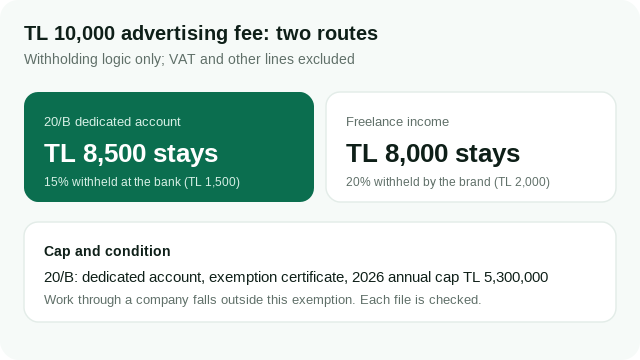
Say a brand pays you a gross TL 10,000 advertising fee. We leave VAT and other lines aside and look only at the withholding logic.
- 20/B account: The bank withholds 15% (TL 1,500); TL 8,500 stays in the account.
- Freelance: The brand withholds 20% (TL 2,000); TL 8,000 reaches you.
This does not mean the exemption is always better. The annual cap, account discipline and documents all count. But the question “the bank took it, should the brand take it too?” is answered here: on the same job, the two withholdings do not stack; the route you choose sets which system applies.
What brands do
On the brand side the work is less fun but very important: the advertising contract, the payment record and, depending on the rules, a payment slip or detailed bank record must be in the file. The brand’s accounts will ask for these. Your contract should say clearly which account and which route the payment uses. If that sentence is vague, both sides may expect a different deduction later.
One practical warning: decide from day one whether the payment goes to your personal exemption account or to your company account. Mixed accounts are the most common problem in the first year.
Four common mistakes
1. Mixing the account. Once exempt-activity income lands in another account or payment tool, the file becomes contestable. Income from your other work does not block the exemption, but the money from the exempt activity should come through its own channel.
2. Not checking the cap monthly. “I didn’t know it was that much” is the most expensive sentence at year-end. Add up the turnover cumulatively every month; if you are getting close to TL 5,300,000, change the plan mid-year, not in December.
3. Writing the contract “later”. If the contract does not say which account, which route and which document the payment uses, the brand and you will expect different withholdings. One clear page of terms prevents the next three arguments.
4. Putting product and fee on one line. If a product shipment and a cash payment sit on the same line, nobody can tell which part is which. Use separate lines and state the product value and the payment apart; it makes the file easier to read.
All four are avoidable with a small setup in the first month. Usually the problem is not the law but the habit of record-keeping.
How the file is built in Ankara
In our Çankaya office we ask three questions in a row: are you working as an individual or through a company? What is your yearly turnover and how much arrives each month? Do you have other income? Those three answers largely decide which route fits. Address: Kültür Mah., İçel Sk. No:3/12, 06420 Çankaya/Ankara — open our office on Google Maps.
For the first meeting bring the last three months of advertising contracts, payment records from brands, your current bank details if you have an account, and a rough annual income estimate. We can also work remotely through online financial advisory.
These incomes often mix with e-commerce or marketplace sales. For the bookkeeping side, see how e-commerce accounting works. The marketplace picture is in tax guide for marketplace sellers.
Frequently Asked Questions
My follower count is small — can I still use the exemption?
Follower count alone is not the measure. What matters is whether the activity fits 20/B, the account condition and the annual cap.
I received a free product — is that income too?
Not every product shipment is treated the same way. It needs a separate look at your file, which is why the contract should name the product and the payment separately.
What happens if I cross the cap?
For that year the exemption is lost and the income is declared in the annual return. You can use the exemption again in later years.
I have a company — is 20/B open to me?
No. The exemption is designed for individuals. Work done through a company needs a different tax file.
Which documents should I keep?
The advertising contract, payment records, the exemption certificate and any receipt or e-SMM. These four items are the ones you will need most at year-end.
In short
If a brand pays you for advertising, first confirm whether you are an individual or a company. As an individual, the 20/B account gives 15% bank withholding and is strong as long as you stay under the cap; otherwise the freelance route and the brand’s 20% withholding apply. Whichever fits, set the contract and the account structure correctly from the start.
To build a file like this together, see our tax advisory and e-commerce accounting pages. Our office is on Google Maps.