In this article
Short answer: In dropshipping you take the order; the goods often leave the supplier’s warehouse for the customer. Having no warehouse does not mean “I am only an agent, no tax / I book only the profit”. Regular sales create a tax registration. You issue the sales invoice to the customer; turnover is the gross sale. The supplier invoices you for the purchase; commission and ads are separate expenses. VAT is, as a rule, computed on the full sale price; input VAT on the purchase is deducted. Blind shipping does not break that chain.
Searches often arrive as “dropshipping tax” or “stockless sales invoice”. This guide breaks the myth: no stock is not no turnover. Monthly books are in e-commerce accounting; formation is in forming a company for e-commerce. The wider marketplace picture is in marketplace sellers.
The café myth
“I have no depot, the product never comes to me, so I need no company.” Second line: “I only invoice the difference.” Both break the file. Ongoing commercial sales open start-of-business and filing duties; a limited company is not mandatory, but registration as a sole trader or a company is. Entity choice is in sole trader or limited company.
The customer buys from your shop or your seller account. You are the legal seller. The supplier sending the parcel from its own depot is logistics; it does not erase the invoice duty.
Who invoices whom?
| Document | Who issues it? | To whom? |
|---|---|---|
| Sales invoice / e-archive | You | Customer (gross price) |
| Purchase invoice | Supplier | Your name |
| Dispatch note | Carrier / consignor | Per dispatch rules |
| Marketplace commission invoice | Platform | You (expense) |
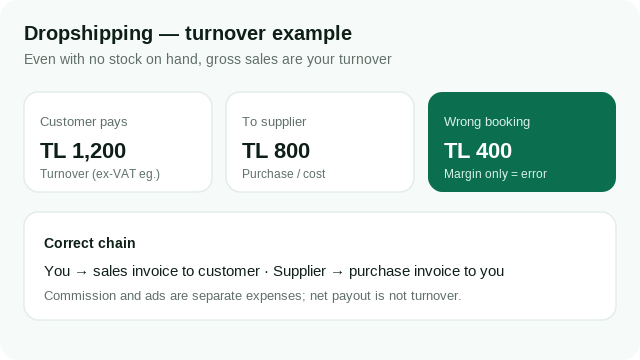
Example (think ex-VAT): the customer pays TL 1,200; you pay the supplier TL 800. Turnover is 1,200, cost 800, gross difference 400. Booking 400 as “this is my turnover” is wrong. On VAT, the base is as a rule the full consideration; computing VAT only on the margin is a common but false shortcut. Input VAT on the supplier invoice is deducted; the period difference is filed.
The supplier not putting a priced invoice in your name inside the parcel (blind shipping) is correct; you send the sales document to the customer digitally. The purchase invoice the supplier owes you is separate and must arrive on time.

Marketplace, commission, withholding
On Trendyol or similar channels, platform commission is an expense; the net that hits the account is not the turnover line. Gross sales, the commission invoice and ads if any must match in the same month. If the marketplace withholds 1%, that line is prepaid tax, not an expense; detail is in e-commerce withholding.
On your own site, payment-institution commission follows the same logic: gross collection is read near turnover; commission is documented separately. Do not shrink turnover because “less hit the bank”.
Foreign supply: not one model
The tax result depends on where the goods and the parties are. Domestic supplier–domestic customer is classic VAT purchase–sale. Foreign supplier–customer in Turkey with goods entering customs can create import VAT. If goods never enter Turkey and go from a foreign supplier to a foreign customer, the VAT scope is read differently; Turkish registration and income/corporate tax still do not vanish from the file. Do not say “dropshipping is exempt” before writing your model in one sentence.
Customs relief thresholds and postal/express rules change often; read the current decision instead of memorising a ceiling. When unsure, import and VAT advice comes first.
Returns, cancellations, “supplier without invoices”
On a return, sales and VAT are corrected; the supplier return is documented separately. On a cancelled order, if a document was issued early it is corrected in the period. “My supplier issues no invoice” does not erase your turnover duty; undocumented purchases weaken expense and input VAT. A regular business is not built on a paperless chain.
As e-invoice / e-archive thresholds grow, stockless sellers pass the same door. Who must switch is in e-invoice and e-archive. If you run the panel from home, address and inspection are in company at home: inspection doorbell.
The file and the office in Ankara
In our Çankaya office we match the shop panel, supplier invoices and marketplace payouts on the same desk. Address: Kültür Mah., İçel Sk. No:3/12, 06420 Çankaya/Ankara — open our office on Google Maps.
Three files are enough for the first meeting: last month’s sales list (gross), supplier purchase invoices, and the platform/payment commission statement. We talk those three lines instead of “I have no depot”. Come by appointment; most reconciliations also run remotely. The remote routine is in online financial advisory.
In Ankara, people moving to a stockless model often leave NACE as “general trade”; the bank or chamber then sticks. Code choice is in wrong NACE code: bank account. Filing days are in the 2026 tax calendar.
The first-month rule is simple: book the gross price on every sale, file purchases and commission apart, and do not treat the net credit as turnover. Stock may be invisible; turnover is not.
Frequently Asked Questions
Is a company mandatory for dropshipping?
A limited company is not required. Regular sales require registration as a sole trader or a company; a permanent “trial without invoices” model does not hold.
Is turnover only the profit margin?
No. The gross sale price from the customer is turnover. Purchases and commission are separate cost/expense.
Is VAT only on the difference?
No. As a rule it is computed on the full sale price; supplier VAT is deducted.
If goods never touch me, do I still invoice?
Yes. You are the seller. The supplier invoices you for the purchase; the sales document to the customer comes from you.
Is the net marketplace payout turnover?
No. Net is after commission and cuts. Gross sales and the commission document are read together.
In short
No stock is not no tax. In dropshipping gross sales are your turnover; purchases and commission are separate; booking only the margin is wrong. The invoice chain sticks to you as seller. The panel, purchases and payouts must match before the month closes.
To build the stockless-sales file together, see e-commerce accounting and tax advisory, and send it to us. Our office is on Google Maps.