In this article
Short answer: There is no special company type for e-commerce. A person who regularly buys and sells opens a tax registration. A one-person test of the business usually starts as a sole proprietorship. If you want a partner, a large stock, or liability limited to the capital, a limited company is formed with TL 50,000 of registered capital. Sellers over the internet whose gross sales reach TL 500,000 in 2022 or a later year must switch to e-invoice. The switch is at the start of the seventh month of the following year.
The search is “forming a company for e-commerce”. The formation itself uses the same door as any other trade in Ankara: the tax office for a sole proprietorship, MERSİS and the trade registry for a limited company. What changes is that the trade runs online and the invoice is issued in the same month as the sale. This guide covers the type, the order and the threshold. The invoice detail is in e-invoice and e-archive. The books of the sale are in how e-commerce accounting works.
Is every online sale a business?
Selling a personal item now and then through a classified ad may not be a trade. Regularly buying goods and selling them on a marketplace or your own site is. Continuity, stock and the aim of profit together call for a tax registration. “I only sell a little, so I do not need to register” does not hold for that second group.
The tradesman exemption is a narrow exception. The threshold and which activities qualify can change each year. It is checked before you start selling. Memorising a figure and opening a marketplace shop is not the way. If there is doubt, describe the activity first, then open the registration. A wrongly claimed exemption breaks at the inspection and at the first platform payout.
A platform asking for your tax number is a sign. Even if it does not ask, a commercial sale does not stay without a document. Money in the bank before an invoice is not turnover. An undocumented collection is next month’s problem. The marketplace tax guide opens that distinction.
Sole proprietorship or limited company?
| Question | Sole proprietorship | Limited company |
|---|---|---|
| Who it fits | One person, testing the business, small stock | A partner, stock that will grow, a corporate buyer |
| Liability | The person is also liable for trade debts | As a rule, the capital committed |
| Capital | No statutory floor | At least TL 50,000 of share capital |
| Tax | Income tax, rising rates | Corporate tax |
| Closing | A cessation notice | Liquidation and deletion from the registry |
The table does not force a choice. A new shop does not have to lock into a limited company before it has seen the return rate and the commission. The reverse is also true. Two partners, a warehouse and high-value purchases should not sit on a sole proprietorship. The measure is expected turnover, stock risk and whether anyone else will own a share. The general comparison is in sole trader or limited company. What e-commerce adds is that the document, the return and the platform’s cut are inside the books from month one.
A limited company formed after 1 January 2024 cannot be formed below TL 50,000 of share capital. That amount is not the cash sitting in the bank that day. How much must be blocked before registration depends on the company type and the registry’s practice. We do not write one percentage as a shared rule for both a sole trader and a limited company. The source of the floor is the minimum capital guide.
In what order does formation run?
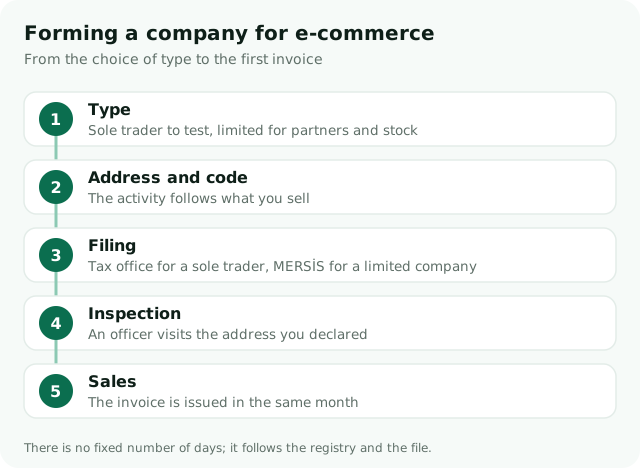
For a sole proprietorship, the start-of-work notice goes to the tax office. The activity is chosen according to what you sell. There is no single code called “internet” that fits every shop. Clothing and spare parts do not carry the same code. The address can be a workplace or, where the conditions fit, a home. At a home address the sign and the work must match what was declared. The inspection visits that address. The detail is in a tax office inspection.
For a limited company the order is MERSİS, the articles, registration at the trade registry, then the tax record. In Ankara the registration is at the Ankara Trade Registry. The number of days depends on the file and the registry’s load that week. We do not write a fixed “it takes three days”. The full list is in company formation in Ankara. E-commerce adds the document and stock routine beside that list. It does not shorten the list.

When does e-invoice arrive?
Under the Tax Procedure Law communiqué, taxpayers who sell goods or services on their own website or on an intermediary’s website, and whose gross sales are TL 500,000 or more in 2022 or a later year, enter the e-invoice system. The switch is at the start of the seventh month of the year that follows the year the condition was met. A seller who crossed the line in 2025 must switch on 1 July 2026. The general turnover threshold is separate and higher. The figure for an internet seller is TL 500,000.
The threshold is not profit. It is gross sales after discounts and returns. Expenses do not shrink it. You may switch before the threshold is reached. A marketplace may want the buyer’s counterparty to be an e-invoice user in the first month of sales. That request can make an early switch sensible. Issuing paper documents after the mandatory date can lead to a special irregularity penalty.
A business that has switched to e-invoice issues an e-archive invoice to a buyer who is not on the system. The two do not replace each other. It is also wrong to treat every new seller as an e-invoice user on the day of formation. The threshold and the date are read together. The steps, including the electronic seal and the e-signature, are in the e-invoice guide. This formation guide does not replace it.
What do the books need once the shop opens?
The invoice to the platform is for the full payout base. Commission, shipping and advertising are not deducted from the invoice to show a smaller amount. They are separate expense documents. The net amount in the bank is not turnover. A return corrects both revenue and stock. Those three sentences are the spine of e-commerce accounting. The line items are in the e-commerce accounting guide and the marketplace guide.
Stock is not left until the month after formation. If goods entered the store before they were sold, the purchase invoice is in that month’s books. A sale without a purchase invoice inflates the remaining profit. A seller shipping from home still has stock. “I am too small to track stock” leaves a count difference at year end.
Several marketplaces attach to one tax registration. You do not open a separate company for each platform. If you do, each one has its own return and its own premium or corporate tax. That is an unnecessary load for most new sellers. The registration is one. Channel reports flow into the same chart of accounts.
What builds up in the first month?
The work of the first month is to issue the document in the month of the sale, not only to make the sale. A late invoice shifts the period of the payout. VAT is calculated in the month the sale belongs to. Without an expense document there is no deductible VAT. The VAT return due by the 28th therefore arrives in the second month after formation. The dates are in the 2026 tax calendar.
For a sole proprietorship, Bağ-Kur starts with the tax registration. The premium is a cash outflow separate from profit. The 2026 amounts are in the Bağ-Kur premium guide. In a limited company the partners’ social security is set up according to whether they work and whether they are managers. Ending both cases with “Bağ-Kur is automatic when you open a company” is wrong. It is automatic for a sole proprietorship. In a limited company the file is read partner by partner.
In Ankara we run this from our office in Çankaya. Most of the papers arrive remotely. The signing and the registry appointment are near Kızılay. The district does not change the filing day. Working by district is in accounting in Ankara.
Formation is not finished when the shop is open. The tax plate, the e-notification address and the first invoice have to sit in the same file. If e-notification is not opened, a letter from the tax office can count as unread. That is the line new sellers miss most often in the first year. The last line of the formation checklist is not “the shop is live”. It is “notification and the first document work”.
Frequently Asked Questions
Do I have to form a limited company for e-commerce?
No. A seller who is one person, testing the business, with a small stock, can open a sole proprietorship. A limited company is considered when there is a partner, a large stock, or a wish to limit liability to the capital. A marketplace does not require every seller to be a limited company.
Is e-invoice required before the first sale?
Not on day one for every new seller. An internet seller whose gross sales exceed TL 500,000 in 2022 or a later year switches at the start of the seventh month of the following year. A platform may ask earlier. Switching before the threshold is also allowed.
Can I use my home address as the workplace?
For many activities a home address can be used. The inspection visits that address. The sign, the stock and the declared activity have to match. If nobody is there, the finding works against the registration.
Do I open a separate company for each marketplace?
No. One tax registration can carry several platforms. A separate company means a separate return and a separate premium. Channel reports are booked in the same set of books.
Can I move from a sole proprietorship to a limited company later?
Yes, but it is not a button. The transfer of stock, open invoices and the closing of the tax record are planned together with the new formation. A rushed closing leaves return and stock differences. The decision costs less work once turnover and any partnership are clear.
In short
An e-commerce company is not a special type. Regular selling needs a tax registration. A sole proprietorship fits a test and one person. A limited company fits partners and stock risk. The limited company’s floor is TL 50,000. E-invoice for internet sales arrives with TL 500,000 of gross turnover and the seventh month of the following year. The shop opens after the invoicing routine exists, not before.
If we handle the formation with you, see e-commerce accounting and company formation, and send us the file.