
In this article
Short answer: The deadline for the minimum capital increase is 31 December 2027. A communiqué published in the Official Gazette on 17 October 2026 moved the date in the Turkish Commercial Code, which had been 31 December 2026. The amount is TL 50,000 for a limited company and TL 250,000 for a joint-stock company. The extension does not cancel the duty. A joint-stock or limited company that has not reached the amount by that date is deemed dissolved.
The search this week comes from that date. The statutory period was going to end in 2026. The Ministry of Trade used the power in provisional article 15 and extended it by one year. The communiqué took effect on the day it was published. A limited company in Ankara whose registered capital still shows TL 10,000, or a joint-stock company still showing TL 50,000, is who this is about.
What are the new amounts?
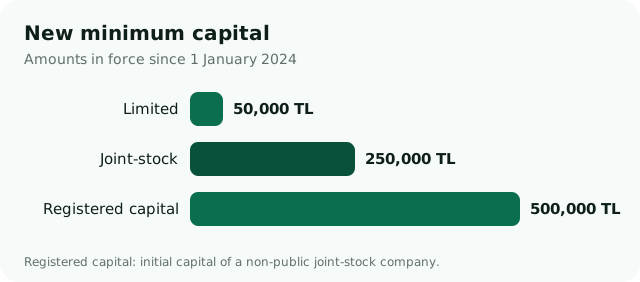
| Company | Previous amount | Statutory minimum | If the deadline is missed |
|---|---|---|---|
| Limited company | TL 10,000 | TL 50,000 | Deemed dissolved |
| Joint-stock company | TL 50,000 | TL 250,000 | Deemed dissolved |
| Non-public joint-stock company on the registered-capital system | Initial capital TL 100,000 | Initial and issued capital TL 500,000 | Deemed to have left the registered-capital system |
The amounts were raised by Presidential Decision No. 7887 of 24 November 2023 and took effect on 1 January 2024. A company formed after that date is formed at this floor. The extended period is for older companies that are still below it. It is not permission to open a new limited company at TL 10,000. The amount at formation is covered in company formation in Ankara, and the choice between a sole proprietorship and a limited company in sole proprietorship or limited company.
The registered-capital row has a different result. A non-public joint-stock company that has adopted the registered-capital system, and whose issued capital is already at least TL 250,000, is not deemed dissolved if it fails to raise its initial and issued capital to TL 500,000. The statute deems that company to have left the registered-capital system. For a joint-stock or limited company below the floor, the result is dissolution.
Who is inside this period, and who is not?
The measure is the capital written in the articles and registered at the trade registry. Cash in the bank, a shareholder receivable, or money the shareholders say they “actually put in” does not replace it. If the registry says TL 10,000 and the shareholders later put cash in the till, that unregistered cash does not make the capital TL 50,000. The registry entry is read first. MERSİS and the latest capital announcement should show the same figure.
A sole proprietorship is outside this communiqué. A sole proprietorship has no capital floor. A courier, a marketplace seller or a self-employed person registered as a sole trader is not dissolved by this deadline. Their question is the type of business. The answer depends on profit and liability. If they move to a limited company, the new company is formed at the TL 50,000 floor. TL 10,000 inside an existing limited company is what this article is about.
A company already at or above the floor is not forced by this communiqué to increase again. A limited company registered at TL 50,000, or a joint-stock company registered at TL 250,000, does not wait on this deadline. An increase to take on a partner, to transfer shares, or for some other reason is a separate decision. That decision does not automatically use the easier quorum in provisional article 15.
A publicly held joint-stock company is not the addressee of this extension. The communiqué names the non-public joint-stock company on the registered-capital system separately. A public company’s capital regime sits in its own legislation. If yours is a closed family joint-stock company, or a limited company with two shareholders, the figure on the registry is what gets read first.

What happens if you do not increase?
Provisional article 15 is plain: joint-stock and limited companies whose capital is below the minimum raise it by the end of the period, otherwise they are deemed dissolved. Dissolution means the company is treated as having ended under the statute. A company that has ended enters liquidation. Being struck from the trade registry does not, on that day, erase the tax registration or the debts. The continuing duties of shareholders and managers are looked at separately until liquidation ends.
The communiqué of 17 October 2026 did not change that result. It changed the date. It is not read as “it moved to 2027, so the subject is closed”. The statute allows the ministry to extend the period by one year at a time, at most twice. This communiqué is that power being used, and it sets the date at 31 December 2027. The file is not shelved on the assumption that a second extension will appear. If it does not, the statutory result is still there at the end of 2027.
For a non-public joint-stock company on the registered-capital system, missing the deadline costs the system. The company is not deemed to have dissolved of itself. If the initial and issued capital have not reached TL 500,000, the company is deemed to have left the system. Most family joint-stock files do not have this row. Where they do, the result is stated apart from the dissolution sentence.
How does the increase proceed?
The first job is to put the registered capital next to the balance sheet. The increase can be in cash. It can also be an internal resource that is sitting on the balance sheet and is fit to be added to capital. Retained profit and a difference coming from capital adjustment are not the same thing. Which of them can be added, and whether adding it creates tax, depends on that line of that balance sheet. The source is chosen before the decision is drafted. “There is money in the till” is not a decision that can be registered.
For the general meeting that makes this increase, no meeting quorum is required. The decision is taken by a majority of the votes present. A privilege cannot be used against this decision. The easing is not a standing rule for every capital increase. Provisional article 15 eases the decision that reaches the statutory minimum. A change that goes above the amount, that changes the number of shareholders, or that creates a privilege returns to its own quorum.
A decision is not capital until it is registered. The minutes, the amendment text and the papers showing the source go to the trade registry. For a company in Ankara the office is the Ankara Trade Registry. The filing is prepared through MERSİS. Until the announcement and the registration are complete, the old figure in the articles remains. 31 December 2027 is the day the registration must be in, not the day the decision is signed. A file left to December can miss the period on an appointment or a missing paper.
How much of the amount is paid before registration, and how much after, depends on the company type and on the source of the increase. A joint-stock company and a limited company do not use the same calendar for a cash commitment. “Put TL 50,000 in the bank tomorrow” is therefore not a one-line instruction. The amount, the source and the payment time are written in the decision. A bank slip is a paper that an internal-resource increase does not require. A cash increase is not filed without the slip.
The increase does not by itself correct the workplace address or the activity code at the tax office. If the trade name, the manager and the address are not changing the same day, those are a separate amendment. If the old address is still there while the capital line changes, an inspection still comes to the old door. Address and sign are separated in a tax-office inspection in Ankara. The capital file and the address file should not be mixed.
Do not wait for 2027
The period looks long. A company whose registry still says TL 10,000 stands with that figure at a bank, in a tender and in front of a new shareholder. A refused loan comes from the small registered capital, not from the communiqué. Leaving the increase to the last quarter of 2027 means joining thousands of files that will pile up at the Ankara trade registry in the same month. A missing paper may not be cured that month.
If one shareholder is leaving, the share transfer and the capital increase are put in order before they are squeezed into the same meeting. The nominal value of the share to be transferred is calculated on the capital before the increase. An increase first, and a transfer second, produces a different percentage. Leaving it as a spoken “your share is twenty percent” produces another percentage at registration. The percentages are written as figures in the decision.
If an internal resource will be used, the balance sheet has to be current. Profit from two years ago cannot be added to capital if it was distributed in between, or if it was closed by a loss. A positive difference from inflation adjustment does not produce the same tax result in every company and every year. The account where the difference sits is read under the rules in force on the day it is added. That reading is tax advisory work. The wrong account can turn an increase into a tax assessment.
If the company has already stopped trading, winding-up and liquidation are discussed instead of a capital increase. Raising an empty limited company to TL 50,000 can enlarge a registration that ought to be closed. A company that has not filed a cessation stays open both at the registry and at the tax office. We draw that line by looking at the file, within company changes and liquidation. In a company that is still trading, the increase is not an alternative to closing. It is the registered figure moving up to the statute.
A new formation and this increase are not the same papers. A person forming a limited company today starts at the TL 50,000 floor. A person who formed one at TL 10,000 in 2018 reaches the same floor by registration of an amendment. Both go to the same registry in Ankara. One is a formation, the other is an amendment. The formation steps are set out separately. This article is for a company that already exists and is still below the floor.
Frequently Asked Questions
What is the deadline for the minimum capital increase?
31 December 2027. The statute said 31 December 2026. The communiqué of 17 October 2026 postponed that date by one year. The day that must be met is the registration at the trade registry, not the signing of the decision.
What is the minimum capital of a limited company?
TL 50,000. For a joint-stock company it is TL 250,000. For a non-public joint-stock company on the registered-capital system, initial and issued capital are TL 500,000. A company formed after 1 January 2024 is formed at these amounts.
Does the company close if we do not raise the capital?
A joint-stock or limited company below the floor is deemed dissolved at the end of the period and enters liquidation. For a non-public joint-stock company on the registered-capital system the result is different: it is deemed to have left that system. A sole proprietorship is outside this rule.
Is a meeting quorum required at the general meeting?
Not for the decision that raises capital to the statutory minimum. The decision is taken by a majority of the votes present, and a privilege cannot be used against it. Other amendments that go beyond the amount follow their own quorum.
Does the increase have to be in cash?
No. Cash can be committed, and an internal resource that is on the balance sheet and fit to be added can also be used. Whether a source creates tax is decided from that balance-sheet line before the increase.
In short
The minimum capital increase now runs to 31 December 2027. The floor is TL 50,000 for a limited company, TL 250,000 for a joint-stock company, and TL 500,000 of initial and issued capital for a closed joint-stock company on the registered-capital system. The period moved. The result stayed: a joint-stock or limited company below the floor that misses the period is deemed dissolved. A sole proprietorship is not inside this duty. The registered figure is read before the cash in the bank.
We can pull the registry entry and the balance sheet of your company in Ankara together for company formation and for a capital amendment, and you can send the file to us. Our office is in Çankaya, near Kızılay. The registration is completed at the Ankara Trade Registry.