
In this article
Short answer: E-commerce withholding is the tax marketplaces such as Trendyol, Hepsiburada and n11 take from the amount they pass to the seller. The rate has been 1% since 1 January 2025. The base is the price of the goods or services excluding VAT and accommodation tax. Commission, shipping and platform fees do not reduce that base. The cut is not an expense; it is prepaid tax to be set off against income or corporate tax.
Searches often arrive as “e-commerce withholding” or “Trendyol tax cut”. Sellers see the bank credit shrink after commission and treat the second cut as a loss. This guide separates the cut, the base and the set-off. Monthly books are in e-commerce accounting; the wider marketplace picture is in tax guide for marketplace sellers.
Who withholds, and who pays?
The marketplace withholds. The seller should not treat the “tax deduction” line on the panel as something they remitted to the tax office themselves; the platform files it on the withholding return. The seller’s job is to set the amount off on provisional and annual returns. The wrong entry breaks both turnover and the tax receivable.
The scope covers payments mediated by electronic commerce intermediary service providers and intermediary service providers under Law No. 6563. A seller who collects by card on their own site does not face this 1% on that channel; that channel has its own tax and documents. Do not mix the two channels in one payout file.
Simplified-method taxpayers, exempt tradespeople and certain social-content creators with an exemption certificate may fall outside the cut. Saying “do not withhold from me” without sending the paper to the platform is not enough. If a cut was made, set-off remains open; if it was not, keep the reason in writing in the file.
How is the base calculated?
| Item | Effect on the base | Note |
|---|---|---|
| Sale price (excl. VAT) | This is the base | VAT and accommodation tax are stripped |
| Commission | Does not reduce it | Expense / service invoice is separate |
| Shipping and service fees | Do not reduce it | Platform cuts do not shrink the base |
| Return (before filing) | May be corrected | Depends on the platform’s books |
| Return (after filing) | Resolved on set-off | Not reversed on the withholding return |
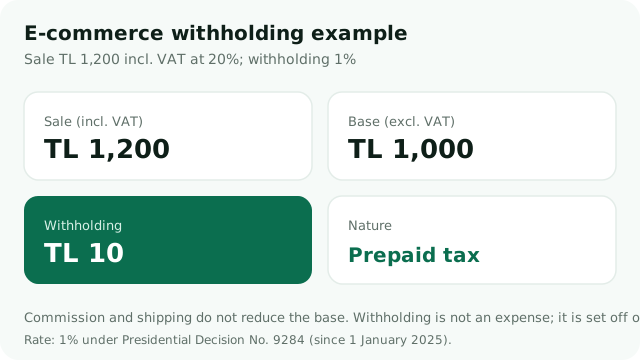
Example: on a sale of TL 1,200 including 20% VAT, the amount excluding VAT is TL 1,000. Withholding is TL 10. The platform pays you TL 10 less; booking that TL 10 as an expense “like commission” is wrong. Expensing it understates profit and damages the set-off right.
With hundreds of lines in a month, the payout and withholding statements matter more than each invoice alone. If the base total on the statement does not match your sales list, write the difference before the month closes. A mismatched month produces “withholding without sales” or the reverse on provisional tax. We keep that reconciliation inside e-commerce accounting.

Set-off and refunds
The cut is set off against tax calculated in the provisional period that includes the related profit. If no tax arises in that period, or the cut is larger, the unused amount can move to a later provisional period in the same year. On the annual income or corporate return, the year’s cuts, the amount used in provisional tax and the balance are read together. Setting the same cut off twice produces a correction.
Amount left after the annual return may be refundable. Cash-refund thresholds and document rules change by year; the petition runs through the Digital Tax Office. Do not wait for an automatic refund because “less hit my account”. Set-off first; then, if needed, open a refund file.
Timing on returned orders matters. If the platform has not yet filed the withholding when the return happens, it may correct its own books. After filing, the withholding return is not rolled back; the seller’s set-off account is where it is discussed. You cannot solve that split without the payout date.
Where does it sit in the books?
Sales revenue is tracked on a gross logic. Withholding goes to a prepaid-tax (tax receivable) account. Booking net payout as “sales income” in one line hides both turnover and the cut. The commission invoice is a separate expense; withholding is not part of that invoice.
In a sole proprietorship, set-off runs through income tax and provisional tax. In a limited or joint-stock company it runs through corporate tax and provisional tax. The young entrepreneur exemption does not claw withholding back; provisional article relief does not affect withholding under article 94. That side is in young entrepreneur tax exemption 2026.
As e-invoice and e-archive duties grow, the platform document and your document must close in the same period. The document transition is in e-invoice and e-archive; the formation order is in forming a company for e-commerce.
Closing the withholding line as an “unknown expense” also burns the year-end refund path. The right account accumulates the cut as a tax receivable and reduces it as provisional tax uses it. Unused balance moves to the annual return. Without that trail, “the platform stole my tax” is not an accounting answer; the cut is prepaid tax by law.
On campaign sales the base is the campaign price the customer paid, excluding VAT. Computing withholding on the list price fights the platform statement. The same rule applies when an order enters the return box: the set-off file carries the base that was actually cut. Guessing inflates next month’s difference list.
If you changed platforms mid-year, download the last three months of statements before the old panel closes. Once the account is deleted, past withholding lines are hard to reach and the set-off file goes blank. Label the first payout on the new platform separately so the two panels do not mix in one sheet.
The file and the office in Ankara
The withholding line follows the same statute in Ankara as in Istanbul. What changes is who holds the file and who posts the return. In our Çankaya office we read the payout, the bank statement and the provisional-tax table on the same desk. Address: Kültür Mah., İçel Sk. No:3/12, 06420 Çankaya/Ankara — open our office on Google Maps.
Three files are enough for the first meeting: the last three months of marketplace payouts, the withholding statements, and the list of amounts that hit the bank. A shop-panel screenshot helps. Filing days are in the 2026 tax calendar; the VAT day and the withholding set-off are not the same sentence.
If a signature or a face-to-face check is needed at the office a short walk from Kızılay, you come by appointment. Most monthly reconciliations run remotely; sending papers by folder or message is enough. The remote routine is in online financial advisory.
Frequently Asked Questions
What is the e-commerce withholding rate?
1%. It was set by Presidential Decision No. 9284 and has applied since 1 January 2025. The base is the sale price excluding VAT.
Is withholding an expense?
No. It is prepaid tax. Expensing it understates profit and damages the set-off right. The commission invoice and the withholding are tracked separately.
Does commission reduce the withholding?
No. Commission, shipping and service fees do not shrink the base. The base is the VAT-exclusive price of the goods or services.
Do I file the cut myself?
No. The marketplace files it on the withholding return. Your job is to set the amount off on provisional and annual returns.
What happens to unused set-off?
After the annual return, any remainder may be refundable or set against other tax debts if the conditions are met. Year-end set-off is finished first.
In short
E-commerce withholding is 1%. The base is the VAT-exclusive sale; commission does not reduce it. The cut is prepaid tax, not an expense. It is set off on provisional and annual returns; a refund file opens only for what remains. The payout and the withholding statement must match before the month closes.
To build your marketplace file together, see e-commerce accounting and tax advisory, and send it to us. Our office is on Google Maps.