
In this article
Short answer: A sole proprietorship is not closed by deletion from the trade registry. A cessation notice goes to the tax office, an inspection may follow, and the Bağ-Kur and chamber records close separately. A limited or joint-stock company enters liquidation. The general meeting decides, a liquidator is appointed, and the name gains “in liquidation”. Known creditors receive registered post. Everyone else receives three notices, one week apart. What remains cannot be distributed to the shareholders until six months after the third notice. Legal personality ends when the company is deleted from the trade registry. Closing the tax record does not close the company.
The search “how to close a company” treats two different jobs as one. Trying to close one with the other’s papers sends the file back. This guide separates them. Closing is not the reverse of opening. Opening is in company formation in Ankara. The choice of type is in sole trader or limited company.
How does a sole proprietorship cease?
A sole proprietorship has no liquidator, no three notices and no “in liquidation” name. The job is to cease the activity. A cessation notice goes to the tax office, through the digital tax office or the office’s own channel. The cessation date is the date of the last invoice and the last stock count. Saying the shop is shut does not replace the notice.
Goods still on hand are sold, returned or documented as withdrawn before the notice. Stock that was not withdrawn stays in the profit calculation. If a marketplace balance is still open, filing the notice before the platform has finished its set-off produces a later gap: sales exist, the taxpayer does not. The last VAT return covers the period that was ceased. The days are in the 2026 tax calendar.
Bağ-Kur does not lose every trace the day the tax record drops. A premium debt is not cancelled by the closing. The chamber record is separate from the tax office. To treat all three as finished on the same day, you read the letter from each. An inspection can visit the address after the cessation notice. If the activity is still there, the registration is opened again. What the inspection looks for is in a tax office inspection.
Turning a sole proprietorship into a limited company is a closing plus a formation. Closing the old record before stock, open invoices and the document series are transferred leaves both sides short. A rushed cessation makes it unclear which record a returned item belongs to. We cover that move, and what changes with the type, in forming a company for e-commerce.
Closing a limited or joint-stock company is liquidation
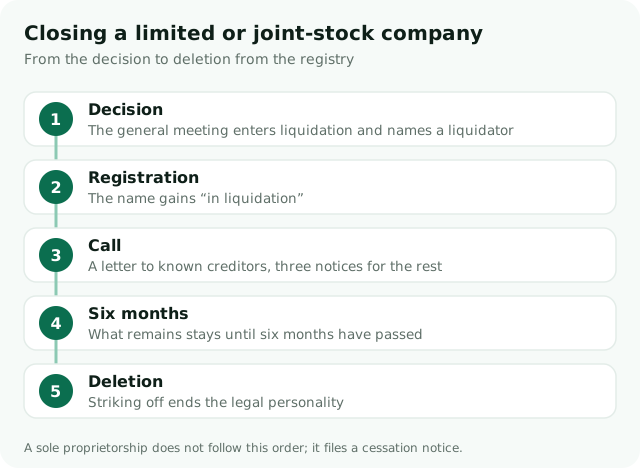
If a statutory ground for ending is met, or the shareholders decide, the company ends. An ended company enters liquidation. That fact is registered and announced at the trade registry. The company keeps its legal personality until liquidation is over. The words “in liquidation” are added to its name. The aim is to turn assets into money, collect receivables, pay debts and finish unfinished work. A new commercial push is not the work of this period.
Liquidators do the work. At least one of them must be a Turkish citizen whose place of residence is in Turkey. A liquidator is appointed by the articles or by a general-meeting decision. If none is appointed, liquidation is carried out by the body the statute names. The liquidator is also registered and announced. In Ankara that registration is at the Ankara Trade Registry. The filing runs through MERSİS.
The general meeting of a limited company and that of a joint-stock company do not use the same papers. Quorum, notice and the minutes follow the type. “We closed it with one petition” is not enough for a capital company. If the agenda did not include liquidation and the choice of liquidator, the registry sends the file back. The number of days depends on a complete file and the registry’s load that week. We do not give a fixed closing time.

Notices, letters and six months
| Stage | What is done | What it does |
|---|---|---|
| Registration | Entry into liquidation and the liquidator are written into the registry | The name becomes “in liquidation” |
| Letter | Registered post to creditors known from the books | A known debt is not hidden |
| Three notices | In the registry gazette, one week apart | Other creditors are told |
| Six months | Counted from the third notice | What remains is not distributed before then |
| Deletion | The final balance sheet is approved and the company is struck off | Legal personality ends with that registration |
The Ministry of Trade’s company-formation guide states the period plainly: what remains cannot be distributed until six months after the third call to creditors. Paying the debts and returning share capital cannot be skipped in favour of that period either. Unless the articles say otherwise, what remains goes to the shareholders in proportion to the capital they paid.
A known creditor is a person who appears in the books or the documents and whose address is known. That person receives registered post. The others are called by three notices, one week apart, in the Turkish Trade Registry Gazette and on the company’s website. Cutting the notices after one publication leaves the call short. The date of the third notice is the start of the six months. Writing an estimated date opens the distribution early.
MERSİS can generate the creditor-call notice electronically when the liquidation filing is made. The notice fee is often collected together with the registration. The gazette copies showing that the notice appeared three times still stay in the file. Without them, the day the six months started cannot be proved.
A closed tax record does not close the company
The tax office can delete the tax record of a company that cannot be found at its address. That does not mean legal personality has ended. If the company registers a new address and returns to activity, the tax registration is opened again. The Istanbul Chamber of Commerce’s registry notice draws the same line: striking a tax record is not deletion from the trade registry. Saying “we have closed” before deletion from the registry leaves the debt and the lawsuit where they were.
A corporate tax return does not stop by itself while liquidation continues. The liquidation period can produce its own profit. A sale of assets, a collected receivable and a debt paid are records of this period. It is wrong to close provisional tax and corporate tax in one sentence. Which return is still filed in the liquidation year is written with the advisor at the start of the period. The calendar guide shows the ordinary days. A liquidation year changes some of those days. It does not delete all of them.
If there are employees, the leaving notice is filed on time, separately from the liquidation decision. The social-security workplace file should be closed before deletion from the registry. An open workplace file is not stopped by the words “the company was deleted”. The hiring side of a first employee is in the first employee checklist. Leaving is the other cover of the same file.
Debt, lawsuits and an early distribution
Asking for deletion while a seizure, a pledge or a registry annotation is in place stalls the file. A pending lawsuit or enforcement proceeding does the same. If a creditor does not come forward despite the three notices, the disputed amount is set aside or deposited in the way the statute describes. Sharing what remains without that set-aside leaves the liquidator facing the creditor who arrives later.
The liquidator submits liquidation statements to the general meeting for each year-end, and a final balance sheet at the end. If liquidation runs past a year, the statement is not skipped because “nothing happened this year”. Deletion is not requested while assets and liabilities are still open on the final balance sheet. The list of amounts distributed to shareholders is an annex of the final decision.
Bankruptcy is a separate path. In bankruptcy, liquidation is carried out by the bankruptcy administration under the Enforcement and Bankruptcy Law. Liquidation entered by a general-meeting decision does not replace bankruptcy. Putting a company that cannot pay its debts into voluntary liquidation with the words “we will publish a notice and close” pushes the creditor and the liquidator into a heavier liability. If insolvency is suspected, the balance sheet is read first. The path is chosen after that.
A company deemed dissolved because its capital stayed below the statutory floor also enters the liquidation rules. The deadline is 31 December 2027. Missing that date is not automatic deletion from the registry. The company is deemed ended, and liquidation starts. The amounts are in the minimum capital guide. We do not present closing as the alternative to the capital increase. They are separate decisions.
Where does the file end in Ankara?
The registry work of a limited or joint-stock company is at the Ankara Trade Registry. The tax work is at the tax office the company is attached to. They do not finish in the same building. Part of the papers is in MERSİS, the part that needs a signature is at the registry, and the return is in the tax office’s system. Our office is in Çankaya, a short walk from Kızılay. The meeting and the signing appointment are there. The district does not change the period.
One check is enough before closing. Is there an open invoice, is stock zero, has the employee notice been filed, is a known debt tied to a letter, is the date of the third notice in the file. If those five answers are not yes, deletion has been requested early. An early request can do more than get refused. It can also lead to a demand that distributed assets be returned.
For a sole proprietorship the same five questions go to the tax office instead of the registry. The last invoice, the last stock, the Bağ-Kur debt, the chamber record and an address ready for inspection. If the address has been abandoned, the inspection weakens the intention to cease. Moving to a new address without declaring it is a change of address, not a closing.
Frequently Asked Questions
Does the company close when the tax record is deleted?
No. The tax office can delete the record. Legal personality ends when the company is deleted from the trade registry. If an address is registered after the tax record was deleted, the tax registration can be opened again.
How long does liquidation take?
What remains is not distributed until six months after the third notice. The whole file runs longer according to debts, lawsuits and the registry’s review. There is no single number of days for every company.
Do I close a sole proprietorship with a gazette notice?
No. A sole proprietorship does not need three notices or a liquidator. A cessation notice goes to the tax office. Bağ-Kur and the chamber record close separately.
Can the company be deleted while it has debts?
What remains cannot be distributed before a known debt is paid or set aside as the statute requires. Asking for deletion while a seizure or a lawsuit is open stalls the file. If bankruptcy is suspected, the path is chosen from the balance sheet before the general-meeting decision.
Can a shareholder be the liquidator?
A shareholder or a manager can be appointed. At least one liquidator must be a Turkish citizen resident in Turkey. The person chosen is registered. A name that was not registered does not count as having signed the notices and the balance sheet.
In short
A sole proprietorship closes with a cessation notice. A limited or joint-stock company enters liquidation, adds “in liquidation” to its name, and sends a letter plus three notices to creditors. What remains is not distributed until six months after the third notice. Legal personality ends when the company is deleted from the registry. A closed tax record does not take the place of that deletion.
If we handle the closing with you, see company changes and liquidation and send us the file.