
In this article
- Who is a sole proprietorship for?
- Step by step
- Required documents
- How much tax does a sole proprietorship pay?
- Business ledger or balance sheet?
- The first month after opening
- Young entrepreneur benefits
- Simplified method and tradesman exemption
- Moving from sole proprietorship to limited company
- Frequently Asked Questions
- In Short
Short answer: To open a sole proprietorship, you set a business address, notify the tax office that you are starting business (online via the Digital Tax Office or in person) and receive your tax certificate after the inspection. Depending on your activity, you register with the chamber of commerce or the tradesmen's chamber, and your Bağ-Kur coverage starts automatically. With documents ready, the process usually takes a few days; there is no capital requirement.
The sole proprietorship is the most common business type in Turkey. It is quick to set up, low cost and relatively simple to account for. Freelance developers, designers, consultants, small traders, e-commerce sellers and motorcycle couriers usually start this way. This guide explains the steps, documents and tax burden for opening a sole proprietorship in Ankara.
Who is a sole proprietorship for?
It is a sensible start for those working alone, with modest profit and wanting to begin quickly. As profit grows or partners come in, moving to a limited company can be considered. If you have not decided, read sole trader or limited company.
The main disadvantage is unlimited liability: you are liable for business debts with your personal assets. For high-risk, large-scale work, a limited company may be more suitable.
Step by step
1. Define your activity and tax type
Your work determines your tax type. Trading goods or services means business income; working independently with professional expertise (consultant, architect, developer) means self-employment income. This affects whether you issue invoices or freelance receipts, which chamber you join and your type of books. See withholding and VAT on a freelance receipt with our freelance receipt calculator.
2. Prepare a business address
A lease or title deed is required. For some activities a home address can be used; a virtual office is also common. The tax office will inspect the address, so it must be real and reachable.
3. Notify the tax office
The start-of-business notice can be filed online via the Revenue Administration's Digital Tax Office or in person. Your financial advisor can handle it for you. The tax office then inspects and your liability begins.
4. Chamber registration and Bağ-Kur
Commercial activities register with the Ankara Chamber of Commerce or the relevant tradesmen's chamber; self-employed professionals belong to their professional chambers. When your tax record opens, social security is notified and Bağ-Kur coverage begins automatically. We cover 2026 amounts in Bağ-Kur premium 2026.
5. Set up invoicing
Most new businesses start with the Revenue Administration's free e-Archive Portal. When turnover exceeds certain limits, e-invoice and e-ledger obligations arise; see e-invoice and e-archive requirements.

Required documents
| Document | Purpose |
|---|---|
| Identity document | Tax registration and inspection |
| Lease or title deed | Verifying the business address |
| Activity details | Setting activity code and tax type |
| Diploma or licence (if needed) | Self-employment and licensed activities |
| Chamber registration | Commerce or tradesmen's chamber |
| e-Government and tax portal access | Online application, e-Archive and e-Notification |
How much tax does a sole proprietorship pay?
The owner pays income tax on annual profit. Tax is progressive: in the 2026 tariff for non-wage income, the first TL 190,000 is taxed at 15%, with subsequent brackets at 20%, 27%, 35% and 40%. The average rate therefore rises gradually with profit.
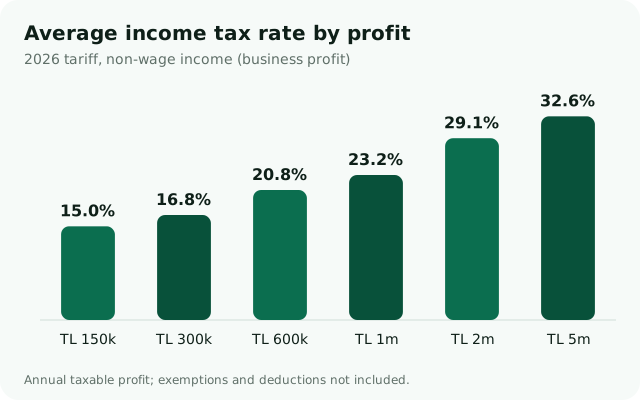
At TL 300,000 annual profit the average rate is about 16.8%, while at TL 2 million it exceeds 29%. Use our income tax calculator with your own figures. For businesses whose profit grows significantly, the tax advantage of a limited company should be assessed.
Sole proprietors are also VAT payers, file a VAT return every month and pay provisional tax quarterly; provisional tax paid is offset against the annual return. Collecting all expense documents is the most effective legal way to reduce taxable profit; see deductible business expenses.
Business ledger or balance sheet?
Sole proprietorships usually keep a business ledger as second-class merchants, recording income and expenses, with the difference forming profit. Businesses whose annual purchases or sales exceed legal limits move to the balance-sheet basis, tracking assets, liabilities and stock in detail. Self-employed professionals keep a self-employment ledger.
The first month after opening
- Open a bank account for the business and separate personal spending.
- Log in to the e-Archive Portal, issue your first invoice and check your details.
- Make sure expense documents carry your name and tax number.
- Pay Bağ-Kur by the last day of the month; on-time payment earns a discount.
- Agree the VAT and withholding calendar with your financial advisor.
This simple routine prevents most year-end document gaps and delays. See all dates in our 2026 tax calendar.
Young entrepreneur benefits
The income tax law provides a young entrepreneur profit exemption for young people registering for the first time who meet the age requirement. Eligible people may also receive one year of Bağ-Kur premium support. Conditions (age, first registration, running the business personally) should be checked carefully; we can assess your case before you apply.
Simplified method and tradesman exemption
Some small businesses may be taxed under the simplified method or use the tradesman exemption. These depend on activity type, location and legal limits, and the conditions have changed in recent years. In metropolitan cities like Ankara, they are limited for many activities, so check current conditions before applying.
Moving from sole proprietorship to limited company
As business grows, you can close the sole proprietorship and form a limited company, or transfer the business into a company. Three signals are watched: profit reaching higher income tax brackets, the need for partners or investors, and large clients requiring a corporate structure. Stock, fixed assets and open accounts must be transferred correctly. We cover the steps in company formation in Ankara.
Frequently Asked Questions
How many days does it take to open a sole proprietorship?
With documents ready, the notice can be filed the same day. Including inspection and chamber registration, it usually completes within a few days.
Is capital required?
No. There is no minimum capital for a sole proprietorship. For a limited company, minimum capital is TL 50,000 as of 2026.
Can I open a sole proprietorship from home?
If the activity allows, you can use your home address. This is common for software, consulting, design and courier work; the tax office inspects the address.
Will I be covered by Bağ-Kur?
Yes. Coverage generally starts automatically when your tax record opens. If you also work as an employee with social security, that coverage takes priority; review this with your financial advisor.
Is a sole proprietorship enough to sell on marketplaces?
Yes. Most marketplaces work with sole proprietors. For commissions, returns and shipping costs, see our tax guide for marketplace sellers.
Is it hard to close a sole proprietorship?
No. You notify the tax office, file final returns and settle any debts. Bağ-Kur ends when the tax record closes.
Can a sole proprietorship run without an accountant?
In theory you can keep your own books, but filing, bookkeeping and deadlines require expertise. In practice, most sole proprietors work with a financial advisor.
In Short
Opening a sole proprietorship is quick and low cost; what matters is starting with the right tax type, activity code and an orderly invoice and expense routine.
We handle opening a sole proprietorship in Ankara and the accounting afterwards. Review our company formation and bookkeeping and accounting pages, or contact us with questions.